From Alliance to Confrontation: Why the U.S.–Iran Conflict May Define the Future of Global Order

The conflict between the United States and Iran is often framed as a modern geopolitical rivalry, but its roots run far deeper, shaped by decades of ideological divergence, strategic mistrust, and fundamentally opposing visions of the world order. What began as a partnership during the Cold War gradually transformed into one of the most persistent and dangerous confrontations in modern international relations. Understanding how this transformation occurred is essential to grasp where it may ultimately lead, especially in a world already strained by instability and competing power blocs.
In the early years, the United States and Iran were not enemies but allies. During the Cold War, Iran was a key strategic partner for Washington, serving as a bulwark against Soviet expansion in the Middle East. This relationship was cemented in 1953 when the United States and Britain supported a coup that restored the Shah to power after the nationalization of oil resources by Prime Minister Mohammad Mossadegh. While critics often highlight this moment as the origin of resentment, it is equally important to recognize the broader context of the time, where preventing Soviet influence was seen as a global necessity. The Shah’s Iran, despite its flaws, aligned itself with Western modernization, economic development, and international cooperation, becoming a pillar of stability in a volatile region.
However, the stability of that era proved fragile. By the late 1970s, internal dissatisfaction with the Shah’s rule, fueled by economic inequality and political repression, culminated in the 1979 Iranian Revolution. This was not merely a political transition but a complete ideological shift. The establishment of the Islamic Republic under Ayatollah Khomeini marked the birth of a regime fundamentally opposed to Western values, liberal democracy, and the global order led by the United States. From that moment onward, the United States was no longer seen as a partner but as an enemy, famously labeled the “Great Satan” in revolutionary rhetoric.
The immediate aftermath of the revolution set the tone for decades of hostility. The seizure of the U.S. embassy in Tehran and the hostage crisis that followed was not just a diplomatic incident but a symbolic declaration of defiance. It demonstrated that the new Iranian regime was willing to challenge international norms and confront the United States directly. This event deeply shaped American public perception and foreign policy, turning Iran into a central focus of concern in the Middle East.
Over the following decades, the conflict evolved into a complex web of indirect confrontations, proxy wars, and strategic competition. Iran expanded its influence across the region by supporting militant groups and non-state actors, many of which targeted U.S. interests and allies. At the same time, the United States responded with sanctions, military actions, and strategic alliances aimed at containing Iran’s influence. Despite the absence of a formal declaration of war, the two nations have been locked in a continuous state of tension, often described as a shadow war.
A central issue in this ongoing conflict has been Iran’s pursuit of nuclear capabilities. Western powers, led by the United States, have long expressed concern that Iran’s nuclear program could be used to develop weapons, fundamentally altering the balance of power in the Middle East. This concern is not merely theoretical but grounded in the broader behavior and rhetoric of the Iranian regime. When a government openly calls for the destruction of another sovereign nation and supports groups that act on those ambitions, the prospect of nuclear capability becomes not just a strategic concern but a global security threat.
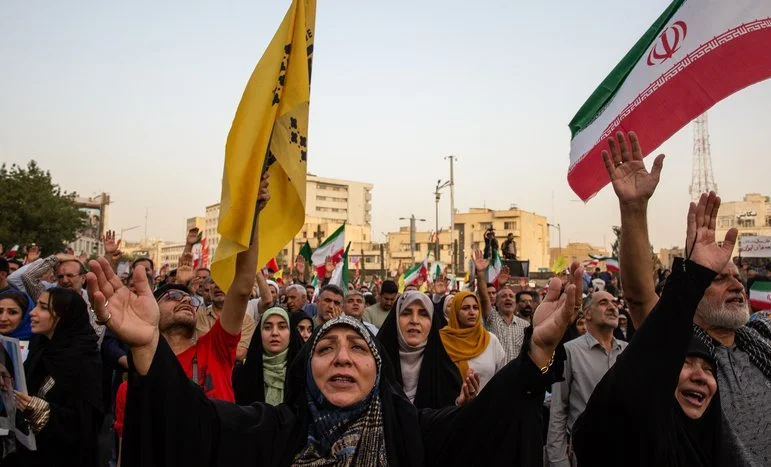
This is where the conflict transcends traditional geopolitics and enters the realm of ideological confrontation. The Iranian regime’s public rhetoric, including chants and symbolic gestures calling for the end of nations like Israel, reflects a worldview that is incompatible with peaceful coexistence. Such actions are not isolated or accidental; they are embedded in the regime’s identity and political messaging. In a world striving for stability and cooperation, the normalization of such rhetoric poses a serious challenge to international order.
From a Western perspective, the issue is not merely about power or influence but about the preservation of a rules-based global system. The United States, along with its allies, represents a model that prioritizes economic integration, political pluralism, and individual freedoms. While imperfect, this system has contributed to unprecedented levels of global prosperity and stability. In contrast, regimes that rely on ideological extremism, suppression of dissent, and external aggression tend to generate instability, both within their borders and beyond.
The involvement of Israel further intensifies the stakes of this conflict. As a key U.S. ally and a nation that has faced direct threats from Iran, Israel represents a frontline in this broader struggle. The consistent targeting of Israel by Iranian-backed groups and the explicit calls for its destruction highlight the existential nature of the threat. Supporting Israel, in this context, is not simply a matter of alliance but a defense of a nation’s right to exist in the face of open hostility.
In recent years, the conflict has entered a more volatile phase. Military strikes, cyber operations, and escalating rhetoric have brought the two sides closer to direct confrontation than at any point in recent decades. The risk of miscalculation is high, and the consequences of a full-scale conflict would extend far beyond the region, affecting global energy markets, economic stability, and international security.
Looking ahead, the trajectory of the U.S.–Iran conflict will likely depend on a combination of internal and external factors. Internally, the sustainability of the Iranian regime is a critical variable. Economic pressures, public dissatisfaction, and generational change could alter the political landscape within Iran. Externally, the resolve of the United States and its allies to counter Iran’s actions will shape the balance of power.
There are essentially two possible paths forward. One is a gradual de-escalation through diplomacy, where Iran reorients its policies and integrates into the international system as a responsible actor. The other is continued escalation, leading to either a direct military confrontation or a prolonged period of instability. Given the current trajectory, the latter appears more plausible unless significant changes occur.
Ultimately, the question is not just about the future of U.S.–Iran relations but about the kind of world that will emerge in the coming decades. A world where aggressive rhetoric and destabilizing actions go unchecked risks descending into chaos. Conversely, a world where such behavior is firmly challenged has the potential to maintain and even expand the stability that has defined much of the modern era.
The idea that a nation can openly call for the destruction of others while seeking greater power raises fundamental questions about accountability and the limits of tolerance in international relations. If global peace and prosperity are to be preserved, there must be clear consequences for actions that threaten those ideals. The U.S.–Iran conflict, in this sense, is not just a bilateral issue but a defining test of the international community’s commitment to a stable and secure world order.
We appreciate that not everyone can afford to pay for Views right now. That’s why we choose to keep our journalism open for everyone. If this is you, please continue to read for free.
But if you can, can we count on your support at this perilous time? Here are three good reasons to make the choice to fund us today.
1. Our quality, investigative journalism is a scrutinising force.
2. We are independent and have no billionaire owner controlling what we do, so your money directly powers our reporting.
3. It doesn’t cost much, and takes less time than it took to read this message.
Choose to support open, independent journalism on a monthly basis. Thank you.