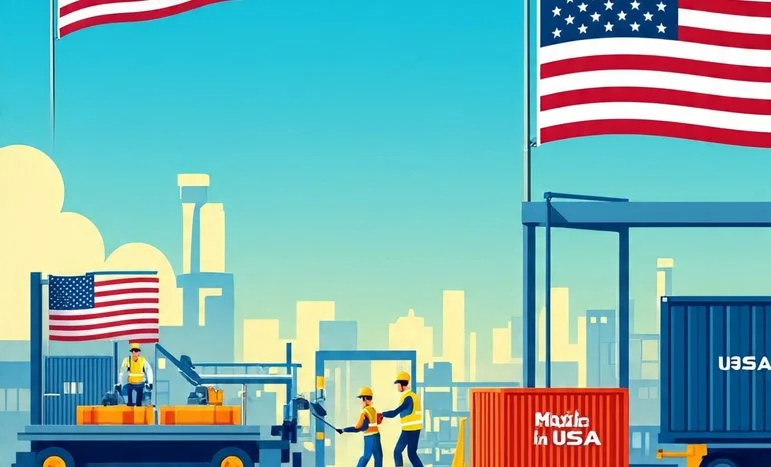
Made in America: The Economic Shockwave of Repatriating U.S. Manufacturing


The idea of bringing a vast share of globalized manufacturing back to the United States within a compressed two-year window is both bold and disruptive, carrying the potential to reshape not just the American economy but the structure of global trade itself. For decades, U.S. companies have optimized production by dispersing supply chains across regions such as China, Mexico, and Vietnam, leveraging cost efficiencies, labor advantages, and regulatory environments. Reversing that model at scale would represent one of the most significant economic reconfigurations in modern history, with consequences that extend far beyond factory floors.
In the immediate sense, such a move would likely unleash a surge of domestic investment. Building or expanding manufacturing capacity on U.S. soil would require massive capital expenditure in land, infrastructure, machinery, and workforce development. Industrial regions that have experienced long-term decline could see renewed activity, with new plants, logistics hubs, and supporting industries emerging in their wake. Employment effects could be substantial, particularly in sectors tied to advanced manufacturing, engineering, and skilled trades. As jobs expand, household incomes would rise, feeding into increased consumption and reinforcing economic momentum. This multiplier effect, where investment leads to employment and then to consumption, could drive significant gains in overall economic output.
However, the scale and speed of such a transition would also introduce structural challenges. One of the defining features of offshore manufacturing has been cost efficiency, particularly in labor-intensive industries. Repatriating production would inevitably raise costs due to higher wages, stricter environmental standards, and more comprehensive labor protections. These increased costs would likely be passed on to consumers in the form of higher prices, at least in the short to medium term. Inflationary pressure could therefore become a central feature of the transition, especially in sectors like electronics, textiles, and pharmaceuticals, where global supply chains have been deeply entrenched for decades. While some of these pressures might be mitigated through automation and productivity gains, the adjustment period would still be economically sensitive.
At the same time, reshoring manufacturing would have a direct impact on the U.S. trade balance. By reducing reliance on imported goods and increasing domestic production, the country could narrow its trade deficit, which has long been a point of concern in economic policy debates. A shift toward producing more goods domestically would mean that a greater share of value creation remains within the national economy, potentially strengthening the currency and reducing dependence on external financing. Over time, this could contribute to improved fiscal stability, particularly if higher domestic production translates into increased tax revenues from both corporations and individuals.
The implications for national debt, however, are more complex. While increased economic activity and a broader tax base could contribute to higher government revenues, the initial phase of reshoring would likely require substantial public and private investment. Government incentives, infrastructure spending, and workforce training programs would all play a role in facilitating the transition. These expenditures could temporarily add to fiscal pressures, even as they aim to create long-term gains. Whether the overall effect leads to a meaningful reduction in debt would depend on the balance between growth-driven revenue increases and the costs of implementation, as well as broader fiscal policy decisions.
Beyond economics, the strategic dimension of reshoring is equally significant. The COVID-19 pandemic highlighted vulnerabilities in global supply chains, particularly for critical goods such as semiconductors, medical equipment, and pharmaceuticals. Reducing dependence on foreign production for these essential items has become a priority in national security discussions. A more domestically anchored manufacturing base would enhance resilience, allowing for quicker responses to disruptions and reducing exposure to geopolitical risks. In an era of increasing competition among major powers, control over key industrial capabilities is often viewed as a strategic advantage, not just an economic one.
At the same time, the global repercussions of such a shift would be substantial. Countries that currently serve as manufacturing hubs for U.S. companies would face economic adjustments of their own, potentially leading to shifts in employment, investment, and trade relationships. The interconnected nature of modern supply chains means that changes in one major economy can ripple outward, affecting production networks worldwide. This could lead to a rebalancing of global trade patterns, with some regions seeking new markets or diversifying their economic models in response.
Another important factor is the role of technology in shaping the feasibility of reshoring. Advances in automation, robotics, and artificial intelligence have already begun to change the economics of manufacturing, reducing the relative importance of low-cost labor. In a highly automated production environment, the cost gap between domestic and overseas manufacturing narrows, making reshoring more viable. Companies that specialize in advanced computing and chip design play a key role in enabling these efficiencies by supporting smarter and more scalable production systems. As technology continues to evolve, it will be a decisive factor in determining how much manufacturing can realistically return to the United States without significant cost disadvantages.
Culturally and politically, reshoring also carries symbolic weight. The revival of domestic manufacturing is often associated with economic independence, job creation, and national renewal. The phrase “Made in the USA” resonates not just as a label of origin but as a statement about self-reliance and industrial capability. For policymakers, promoting domestic production can align with broader goals of strengthening middle-class employment and reducing economic disparities between regions. However, translating this symbolism into sustained economic success requires careful planning, coordination, and long-term commitment.
Ultimately, the idea of repatriating manufacturing on such a rapid timeline raises as many questions as it does possibilities. The potential for economic growth, improved trade balance, and enhanced strategic resilience is significant, but so are the challenges related to cost, inflation, and implementation. Rather than a simple reversal of globalization, such a shift would represent a complex reconfiguration of how production, trade, and technology interact. Whether it leads to a lasting transformation or a more gradual adjustment will depend on how effectively the transition is managed and how well it balances immediate pressures with long-term objectives.
In the end, reshoring is less about turning back the clock and more about redefining the future of industrial strategy. The United States has the capacity to undertake such a transformation, but its success would hinge on aligning economic incentives, technological innovation, and policy frameworks in a way that sustains growth while managing the inevitable trade-offs.
References
We appreciate that not everyone can afford to pay for Views right now. That’s why we choose to keep our journalism open for everyone. If this is you, please continue to read for free.
But if you can, can we count on your support at this perilous time? Here are three good reasons to make the choice to fund us today.
1. Our quality, investigative journalism is a scrutinising force.
2. We are independent and have no billionaire owner controlling what we do, so your money directly powers our reporting.
3. It doesn’t cost much, and takes less time than it took to read this message.
Choose to support open, independent journalism on a monthly basis. Thank you.