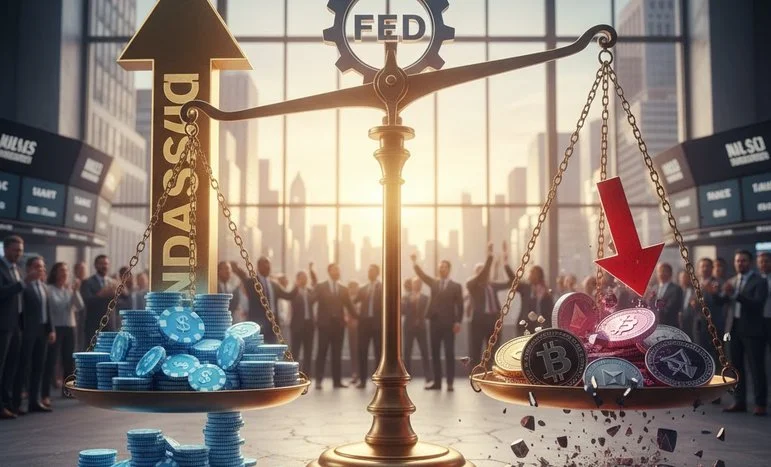
U.S. Bank Losses Revive 2008 Crisis Fears Amid Private Credit Exposure
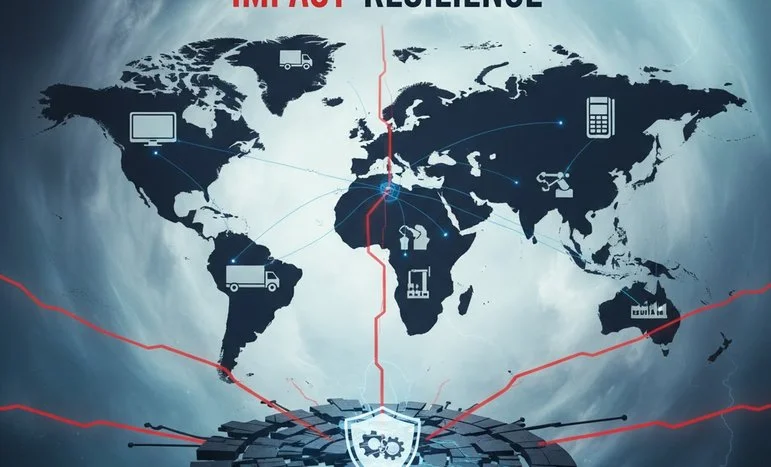

Global markets experienced renewed turbulence this week as fears of a 2008-style financial crisis made an unsettling return to the financial landscape. U.S. banks disclosed over $395 billion in unrealized losses, a figure that immediately sparked investor anxiety and triggered widespread selloffs across financial sectors worldwide. The revelation has sent shockwaves through trading floors and investment committees, bringing back uncomfortable memories of the last major financial meltdown that nearly collapsed the global banking system.
These mounting losses, primarily driven by sustained interest rate shocks and increasingly concerning exposure to private credit markets, have reignited deep-seated concerns about systemic risk and the fundamental fragility of regional banking institutions across America. The situation has evolved from a manageable concern to a potential threat that could ripple through the entire financial ecosystem if left unchecked or if conditions deteriorate further in the coming months.
Finance newsletters and market analysts across the spectrum are now amplifying comparisons to the dark days of 2008, suggesting with growing conviction that the current volatile mix of tight liquidity conditions, opaque credit instruments that lack transparency, and loss-marked balance sheets could potentially escalate contagion risks not just domestically but on a global scale. The parallels being drawn are both stark and worrying for anyone who remembers the panic and uncertainty that gripped markets during the previous crisis. The troubling data, revealed through recent quarterly filings that banks are required to submit to regulators, shows a mounting and accelerating strain on bank balance sheets that has been building over several quarters. Unrealized losses, which essentially represent the gap between the book value of assets held on balance sheets and their current market value in today’s trading environment, have climbed above the psychologically significant threshold of $395 billion. This figure is not just a statistical anomaly but represents real economic pressure on financial institutions that must account for these paper losses even though they haven’t sold the underlying assets.
This level represents one of the highest concentrations of paper losses recorded since the global financial crisis shook the foundations of the international banking system more than fifteen years ago. The persistence of higher-for-longer interest rates continues to systematically erode bond valuations and degrade the quality of loan portfolios that banks accumulated during the era of near-zero interest rates. What seemed like sound investments and prudent lending during the low-rate environment has transformed into a burden as the cost of capital has surged and asset values have declined correspondingly.
Adding substantially to the mounting pressure facing financial institutions, many regional and mid-sized banks have quietly and significantly expanded their exposure to private credit markets, a shadow-lending sector that has mushroomed to exceed $2.1 trillion globally. This expansion happened largely outside the public eye, as banks sought higher yields in an environment where traditional lending margins were compressed. The appeal of private credit was undeniable during the low-rate years, offering attractive returns that seemed almost too good to pass up for institutions hungry for profitability.
Unlike traditional loans that are originated, underwritten, and held according to well-established banking practices, these private credit instruments often lack transparency and regulatory oversight while carrying substantially higher default risks, especially in an economy that shows signs of slowing down. The opacity of these markets means that even sophisticated investors and bank management teams may not fully understand the true risk profile of their holdings until defaults begin to materialize. With rising defaults among highly leveraged borrowers becoming increasingly apparent in recent months, analysts are issuing stark warnings that valuation markdowns could cascade rapidly across entire portfolios, triggering a domino effect that could spread from institution to institution.
Following the public disclosures of these massive unrealized losses, major U.S. and European stock indices experienced broad and sharp selloffs, with bank stocks predictably leading the declines across all market segments. The KBW Regional Banking Index, a key benchmark for tracking the health of regional banking institutions, plummeted over 4% in a single trading session, reflecting the deep concern among investors about the sustainability and resilience of these smaller banks. Global investors responded by rapidly rotating their portfolios toward traditional safe-haven assets such as gold and Treasury bonds, seeking shelter from what they perceive as gathering storm clouds over the financial sector. Hedge funds and sovereign wealth funds, always among the first movers when market conditions shift, have reportedly begun trimming their exposure to regional banks and private credit vehicles in significant amounts. Their actions reflect mounting concerns about liquidity constraints and unclear counterparty risks that could leave them exposed if a cascade of failures were to begin. The institutional exodus from these positions has only accelerated the downward pressure on valuations, creating a self-reinforcing cycle of selling that feeds on itself.
Financial experts and veteran market observers are urging caution while trying to provide perspective on whether the current situation truly mirrors the catastrophic conditions of 2008. They point out that today’s banking system operates under fundamentally stricter capital requirements, more rigorous stress testing regimes, and maintains substantially larger liquidity buffers that were introduced specifically in response to the lessons learned from the last crisis. The regulatory architecture built over the past fifteen years was designed precisely to prevent a repeat of the cascading failures that characterized 2008, and these safeguards do provide meaningful protection.
However, even these experts acknowledge that the alarming speed at which unrealized losses are accumulating across the banking sector, combined with the persistent lack of full transparency in private credit markets, poses entirely new challenges that regulators may not be fully prepared to address. The interconnectedness of modern financial markets means that problems can spread at digital speeds, far faster than during previous crises when information traveled more slowly and intervention could be more measured. One senior economist at a major investment bank captured the dilemma perfectly by noting that while the system is undoubtedly safer than it was in 2008, it is certainly not immune to systemic shocks, and opacity in private credit markets represents exactly the kind of blind spot that regulators fear most in the current environment.
The parallels being drawn to 2008 lie not in the specific types of assets that are causing concern, but rather in how risks are distributed throughout the system and how those risks are being perceived by market participants. During the previous crisis, the toxic assets were primarily mortgage-backed securities and their derivatives that spread contagion throughout the global banking system. Today, the concerning assets are private loans and leveraged funds that have proliferated in the shadows of the regulated banking system, creating similar interconnections and dependencies that could transmit shocks across institutions.
When markets collectively lose confidence in the stated valuations of assets, liquidity has a tendency to evaporate with stunning speed, triggering forced selloffs that can ultimately pressure even fundamentally healthy institutions that happen to be caught in the crossfire. The history of financial crises demonstrates repeatedly that perception can become reality when enough market participants act on their fears simultaneously. The critical question facing policymakers and market participants now is whether coordinated policy responses, potentially including emergency liquidity lines, strategic interest rate adjustments, or explicit government backstops, can successfully stabilize market confidence before the stress metastasizes and spreads to healthier parts of the financial system.
The Federal Reserve and the FDIC have been closely monitoring the evolving situation with increasing attention, with multiple reports suggesting that early stage discussions are already underway around targeted relief measures specifically designed for smaller banks that find themselves heavily exposed to long-term securities that have declined sharply in value. These discussions represent an acknowledgment by regulators that intervention may become necessary if conditions continue to deteriorate, though officials are understandably reluctant to act prematurely and potentially signal that the situation is worse than markets currently believe.
Meanwhile, the Treasury Department is reportedly engaged in intensive talks with major lenders and various regulatory agencies to comprehensively assess credit risk concentration within private markets and determine whether systemic vulnerabilities exist that could threaten broader financial stability. These interagency discussions represent a recognition that the complexity of modern finance requires coordination across multiple jurisdictions and regulatory frameworks to effectively address emerging threats before they metastasize into full-blown crises.
The European Central Bank and the Bank of England have also publicly signaled their readiness to coordinate responses with their American counterparts if cross-border exposures and international funding linkages begin to destabilize broader funding conditions in global markets. The international nature of modern banking means that a crisis originating in U.S. regional banks could quickly spread to European institutions through various channels, making coordinated action essential for containing any potential contagion.
Investor sentiment has undergone a dramatic shift toward pronounced risk aversion in recent weeks, with institutional players now demanding unprecedented access to loan-level data and detailed counterparty exposure maps to properly assess the complex chains of exposure that link financial institutions together. The demand for transparency has intensified as investors recognize that the opacity of private credit markets makes it difficult to determine where risks truly reside and which institutions might be vulnerable to cascading losses. Social media platforms and influential finance newsletters have further amplified the contagion narrative, deliberately or inadvertently reviving collective memories of 2008’s cascading institutional failures and the panic that gripped markets during that terrifying period.
Still, not all analysts agree that crisis fears are entirely justified at this stage, with some arguing forcefully that the concerns may actually be overstated given the demonstrable capital resilience and deposit stability that characterizes most U.S. banks today. These more optimistic voices point to the substantial improvements in bank capitalization, the diversification of funding sources, and the active involvement of regulators as reasons to believe that the system can weather the current storm without experiencing systemic failures. They suggest that the market reaction may be disproportionate to the actual risks, driven more by fear and trauma from past crises than by current fundamentals.
The coming weeks and months will ultimately determine whether these massive unrealized losses remain purely paper concerns that can be absorbed over time as markets stabilize, or whether they evolve into a genuine liquidity-driven crisis that threatens the solvency of vulnerable institutions. Much depends on the trajectory of interest rates, which could either exacerbate losses if they remain elevated or provide relief if they decline. Equally important will be the performance of underlying borrowers in the private credit markets, as any acceleration in defaults would force immediate recognition of losses and could trigger the cascade that markets fear.
Regulatory confidence-building measures will also play a crucial role in determining outcomes, as clear communication and decisive action from authorities can help stabilize markets even in the face of genuine problems. If markets gradually stabilize and deposit bases hold firm across the banking sector, this episode may ultimately be remembered as a contained correction, serving as a sobering reminder of financial fragility rather than a full replay of the 2008 catastrophe. The resilience of the deposit base will be particularly critical, as deposit flight was a key accelerant during previous banking crises and remains one of the most feared dynamics among regulators and bank management teams. But if credit markets seize up and lending grinds to a halt, or if defaults in private credit markets begin to accelerate beyond current projections, systemic risks could resurface with frightening speed, potentially overwhelming even the enhanced regulatory safeguards that have been put in place. The interconnected nature of modern finance means that problems in one segment can quickly spread to others, creating feedback loops that are difficult to break once they gain momentum.
The resurgence of 2008 crisis fears serves to underscore a fundamental and enduring truth about financial systems that remains valid regardless of regulatory improvements or technological advances. Financial systems, no matter how comprehensively regulated or how technologically sophisticated, remain inherently vulnerable to self-reinforcing cycles of confidence and leverage that can amplify both booms and busts. The current situation with U.S. banks reporting $395 billion in unrealized losses serves as a stark warning sign of how quickly and dramatically market conditions can shift when subjected to the sustained pressure of interest rate hikes and the revelation of previously opaque lending exposures that were hidden during better times.
While the current situation has not yet developed into a full-blown crisis requiring emergency interventions and government bailouts, it nonetheless reveals with uncomfortable clarity the profound interconnectedness of modern finance and the critical importance of transparency and robust regulation in preventing history from repeating itself in devastating fashion. The lessons of 2008 remain relevant today, reminding us that vigilance and prudent risk management can never be abandoned, even during periods when markets seem stable and risks appear contained beneath the surface.
We appreciate that not everyone can afford to pay for Views right now. That’s why we choose to keep our journalism open for everyone. If this is you, please continue to read for free.
But if you can, can we count on your support at this perilous time? Here are three good reasons to make the choice to fund us today.
1. Our quality, investigative journalism is a scrutinising force.
2. We are independent and have no billionaire owner controlling what we do, so your money directly powers our reporting.
3. It doesn’t cost much, and takes less time than it took to read this message.
Choose to support open, independent journalism on a monthly basis. Thank you.