Syrians Celebrate the Fall of Bashar al-Assad After Five Decades of Dynastic Rule
In a historic turn of events, Syrians from various regions are celebrating the ousting of Bashar al-Assad, marking the end of a dynastic rule that has lasted more than five decades. The fall of Assad has sparked a wave of jubilation across towns and cities that have long been afflicted by conflict, repression, and economic hardship.
For many, the news of Assad’s exit from power has been met with joy reminiscent of the early days of the Syrian civil war, when protests erupted in 2011 against his authoritarian regime. Citizens in the southern provinces of Sweida and Daraa, along with residents in Homs, took to the streets to express their relief and hope for a new beginning. The atmosphere was charged with optimism as people waved flags and chanted slogans calling for freedom and democracy.
The momentous change in leadership comes after a culmination of events that have seen the Assad regime lose significant control over key areas. Reports suggest that a coalition of rebel groups, supported covertly by regional powers, have effectively dismantled the government’s stronghold in several provinces. The rebellion’s success can be attributed to strategic alliances formed among various factions, including the Army of Islam and al-Nusra Front, now known as Hay’at Tahrir al-Sham. This cooperation has shifted the balance in the conflict, which has claimed hundreds of thousands of lives and displaced millions since it began.
-
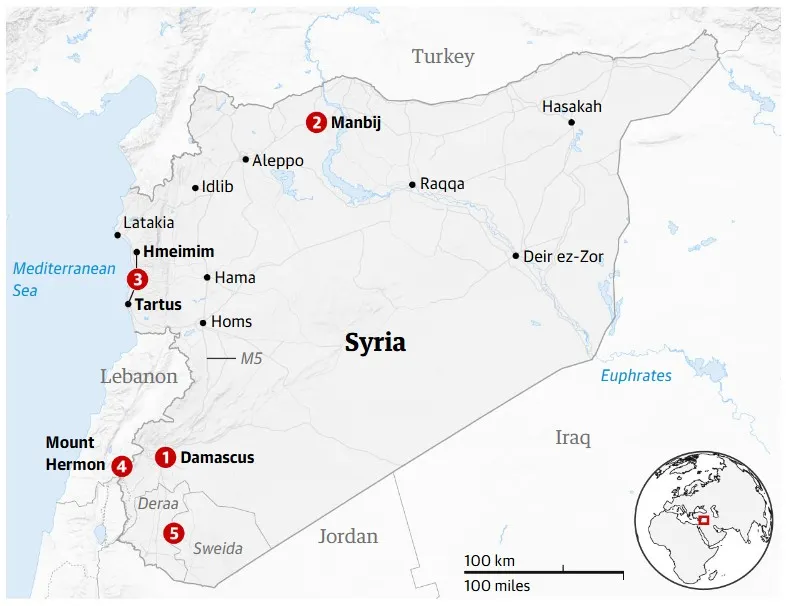
Damascus: Syrian anti-government rebels declared they had ousted Bashar al-Assad after seizing control of the capital on Sunday. Israel conducted three airstrikes against a major security complex in the city’s Kafr Sousa district.
-
Manbij: Turkish-backed Syrian forces entered the northern city of Manbij after taking control of most of the surrounding area from US-allied Kurdish forces, according to reports.
-
Tartus and Hmeimim: The Russian foreign ministry said its two military facilities had been put on high alert, but there was “no serious threat to their security.”
-
Mount Hermon: Israel’s Channel 12 showed pictures of Israeli armored vehicles on top of the Syrian part of Mount Hermon.
-
Deraa and Sweida provinces: Israeli airstrikes were also reported here.
According to sources, the tipping point came when discontent grew within the regime’s ranks, leading to defections and a weakening of loyalty among Assad’s military forces. In recent weeks, strategic offensives in areas such as Daraa and Homs have been successful, forcing Assad to retreat and ultimately resign. Analysts suggest that the complex dynamics among various local and international actors created the “perfect storm” for his downfall.
The role of neighboring countries, particularly Qatar, has been highlighted as significant. Qatar’s involvement in facilitating dialogue among opposition groups has helped foster a united front against the regime. The Qatari government, which has long been a vocal critic of Assad, played a vital role in supporting efforts to consolidate fractured rebel factions into a more coherent force.
Residents celebrated not only in the streets but also via social media platforms, where hashtags expressing relief and hope trended internationally. “It’s a new chapter for Syria,” one activist tweeted, echoing sentiments shared by countless others who have long awaited change. As festive gatherings erupted, families reflected on the suffering endured over the years, with many hoping to return to the homes they were forced to leave during the civil unrest.
International reactions have emerged, with many countries cautiously welcoming the news of Assad’s ouster. The United States and European nations have voiced support for a peaceful transition and the establishment of a governance structure that reflects the will of the people. However, challenges remain as the country looks to rebuild from the devastation left in the wake of the long-standing conflict.
While the fall of Assad signifies a victory for many Syrians, the future remains uncertain. Various factions within the opposition controlling different territories may lead to competing interests and tensions. Observers warn that without a unified approach to governance and peacebuilding, Syria could face further instability.
For now, though, Syrians are embracing this moment of change with hope and determination, making it clear that they desire a future free from the shadow of authoritarianism. As celebrations continue, the world watches closely, recognizing that the path forward will require both domestic efforts and international support to ensure a lasting peace and a new beginning for Syria.